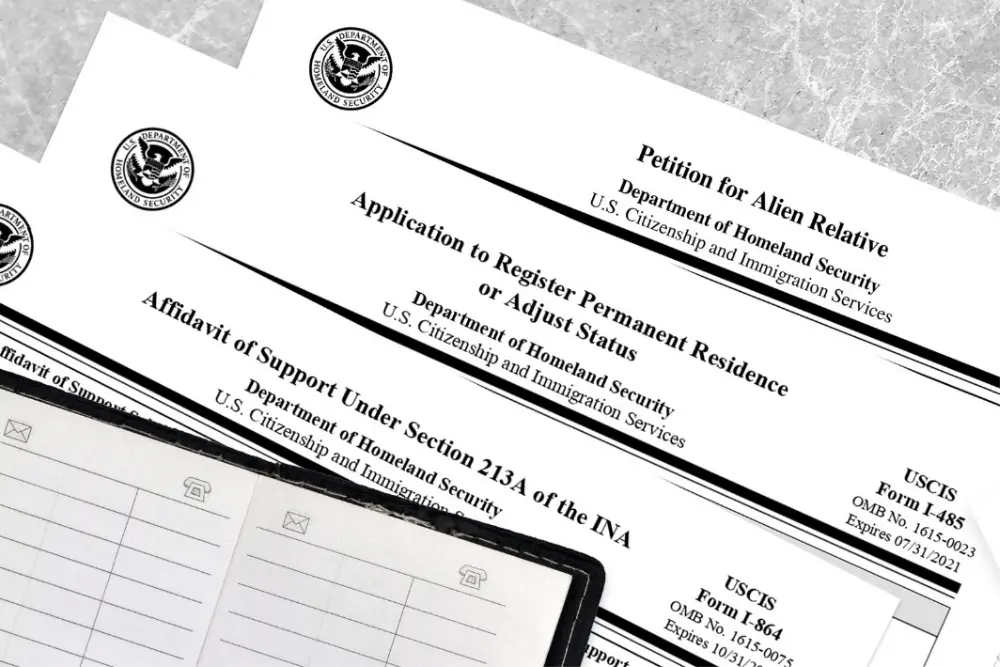
For families assembling a green card application, Form I-864 has long been one of the most consequential pieces of paperwork in the file. It asks a U.S. sponsor to document income, household size, tax history, and, in some cases, assets. Now the form carries a new financial privacy provision that deserves close attention.
On August 31, 2026, U.S. Citizenship and Immigration Services published a new edition of the Affidavit of Support. The revised form authorizes USCIS to request information about a sponsor from one or more consumer reporting agencies. In practical terms, the new Form I-864 gives the government permission to obtain consumer-report information while deciding whether the financial sponsorship is sufficient.
The change took effect immediately. There was no grace period for the previous form, and that may be the most urgent part of the announcement for people preparing to file.
What families should know right away
- USCIS published the new 08/24/26 edition of Form I-864 on August 31, 2026.
- USCIS will not process or accept the prior 10/17/24 edition if it is postmarked or electronically submitted on or after August 31, 2026.
- The new form includes a privacy release that allows USCIS to request information from consumer reporting agencies.
- A credit or security freeze could prevent USCIS from accessing information it considers necessary to review the form.
- USCIS has not announced a minimum credit score, and it has not said that a lower score automatically disqualifies a sponsor.
A form prepared last week may already be outdated
Consider a family that completed its immigration packet near the end of August but planned to mail it after Labor Day. The financial information may still be correct. The signatures may be in place. Every supporting document may be ready. Yet if the Form I-864 carries the 10/17/24 edition date, USCIS says it will not process or accept it when submitted on or after August 31.
That is an unusually abrupt transition for a form used in many family-based green card cases. USCIS sometimes allows applicants to continue using an older edition for a limited period. This time, according to the agency’s official Form I-864 announcement, the new version became mandatory on the day it was published.
Anyone who downloaded the form before August 31 should open the file and look at the footer on every page. The current edition should read 08/24/26. A saved copy on a computer, a form supplied by a friend, or a version stored in an older application package may no longer be usable.
What the USCIS I-864 credit check provision actually does
The new language appears in the sponsor’s declaration. By signing the 2026 Form I-864, the sponsor authorizes USCIS to request information from one or more consumer reporting agencies.
USCIS also added a warning about frozen credit files. If a sponsor has a credit or security freeze, the agency says it may be unable to access information needed to assess the sufficiency of the Affidavit of Support. USCIS advises sponsors to respond promptly if they receive a request to release the freeze.
That wording matters. USCIS is not telling every sponsor to remove a freeze before filing. It is saying that a freeze may become an obstacle if the agency seeks consumer-report information. A sponsor who receives such a request should confirm that it is genuine, understand what access is being requested, and respond within the stated deadline.
What USCIS has not said
The phrase “credit check” can easily create the impression that immigration sponsors will now be judged like people applying for a mortgage or credit card. The announcement does not go that far.
USCIS has not published a minimum credit score for an immigration sponsor. It has not said that a missed payment, limited credit history, or high balance automatically makes a Form I-864 insufficient. It also has not said that it will obtain the same type of report in every case.
Nor has USCIS instructed every sponsor to include a personal credit report or credit score with the initial filing. The agency’s current checklist continues to emphasize federal tax returns, Forms W-2 and 1099, current income evidence, and documentation of assets and liabilities when assets are used to qualify.
For now, the most accurate conclusion is a measured one: USCIS has added consumer-report information to the financial records it may request when reviewing a sponsor. How officers will use that authority across individual cases may become clearer as the agency issues further guidance and begins applying the new form.
Who may be affected by the Form I-864 change?
The Affidavit of Support is required in most family-based immigration cases and certain employment-based cases involving a qualifying family relationship or ownership interest. The new USCIS I-864 credit check authorization may therefore matter to:
- U.S. citizens sponsoring a spouse, parent, child, or other qualifying relative;
- Lawful permanent residents sponsoring eligible family members;
- Petitioners in marriage-based green card cases;
- Joint sponsors who agree to meet the financial requirements;
- Substitute sponsors in qualifying cases; and
- Certain sponsors connected to employment-based immigrant petitions.
USCIS also released new 08/24/26 editions of Form I-864A and Form I-864EZ. A filing package may contain more than one financial form, particularly when household income is combined or a simplified affidavit is used. Each document should be checked separately.
Why sponsor credit history may raise questions
Form I-864 has never been simply a promise written on paper. It is a legally enforceable commitment to support the intending immigrant under the terms established by federal law. USCIS reviews whether the sponsor has enough qualifying income or assets and whether the evidence supports the figures reported on the form.
Consumer-report information could provide another point of comparison. An address, debt, liability, or other financial record may not match what appears elsewhere in the filing. A difference does not necessarily make a sponsor ineligible. It may, however, prompt closer review or a request for additional evidence if USCIS concludes that the existing record does not establish the affidavit’s sufficiency.
This is one reason sponsors should review the entire financial picture before signing. Tax records, current employment, household size, assets, debts, and information on related forms should tell a consistent story.
Seven steps sponsors can take now
- Download Form I-864 directly from USCIS. Avoid relying on a saved copy or an unofficial form library.
- Check the edition date on every page. For filings submitted on or after August 31, 2026, the footer should show 08/24/26.
- Inspect every related sponsorship form. Confirm the current editions of Form I-864A or I-864EZ if either one is part of the case.
- Compare the form with current financial records. Review tax transcripts, wage documents, employment letters, assets, and reported liabilities for accuracy and consistency.
- Find out whether a credit freeze is active. Knowing that a freeze exists will make it easier to respond if USCIS requests access.
- Do not release sensitive information based on an unverified message. Confirm that any request came from USCIS and relates to the pending case.
- Resolve sponsorship concerns before filing. If the sponsor’s income may be insufficient or a joint sponsor may be needed, address that issue before the application is submitted.
Get guidance before submitting Form I-864
Arce Immigration Law assists individuals and families with family-based green cards, adjustment of status, and consular processing. Our team can review the form edition, household-size calculation, financial evidence, and potential need for a joint sponsor.
If you are preparing a green card case or have questions about the new Form I-864 2026 requirements, schedule a private consultation with Arce Immigration Law or call +1 305-330-6262.
Frequently asked questions
Does a low credit score automatically disqualify an immigration sponsor?
No published USCIS rule establishes a minimum credit score for Form I-864 sponsors. A lower score does not automatically mean that the sponsor is ineligible. USCIS will review the affidavit and its supporting evidence under the applicable financial requirements.
Must I include my credit report with Form I-864?
USCIS has not instructed every sponsor to submit a personal credit report or score with the initial filing. The new form authorizes the agency to request information from consumer reporting agencies.
Should I remove a credit freeze before filing?
The USCIS announcement does not direct every sponsor to remove a freeze in advance. It advises sponsors to respond promptly if the agency requests that a freeze be released. Any request should be verified before the sponsor acts.
What happens if I submit the old Form I-864?
USCIS says it will not process or accept the 10/17/24 edition if it is postmarked or electronically submitted on or after August 31, 2026. Use the 08/24/26 edition and check the footer on every page.
Does the new credit provision replace the income requirement?
No. Sponsors must still meet the applicable financial requirements and submit the evidence required by USCIS. The consumer-report authorization is an additional review tool. It does not replace the income, household-size, tax-document, or asset rules.